
Insights from the Webinar: How to Develop Confident Multilingual Writers
You hand out a writing prompt, and half the room goes quiet. Your multilingual learners have plenty of ideas, but getting them onto the blank page feels impossible. Somewhere along the way, many have come to believe they can’t write well in English. That belief can change.
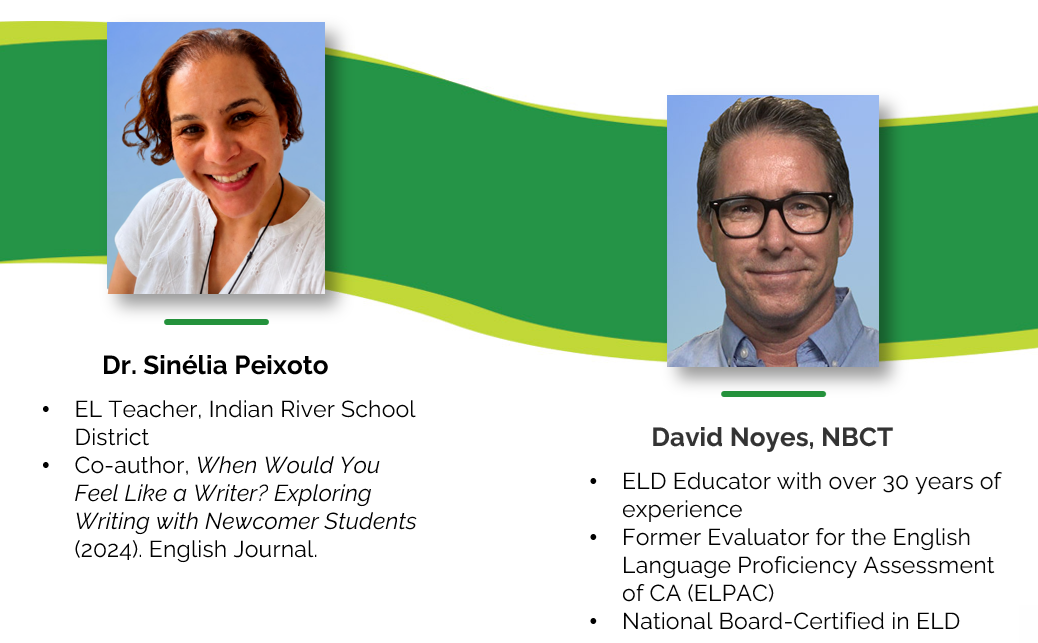
The most effective writing strategies for multilingual learners pair two things: a classroom where students feel safe taking risks and scaffolds matched to each student’s proficiency level. In a recent webinar, two veteran educators showed how to build both. Presenting were David Noyes, NBCT, Head of Curriculum at Language Tree Online, and Dr. Sinélia Peixoto, an educator, award-winning author, and literacy researcher. Together, they bring 60 years of experience teaching multilingual learners. In this post, we’ll highlight the main takeaways from the webinar.
1. Create a "Safe Space" for Students
Writing breakthroughs require students to do things differently and take risks. And they won’t take risks until they feel safe enough to open up. Here are some suggestions on how to create a safe space for your learners.
Do Daily Check-ins
Open class by asking students how they feel, and rotate the format weekly: a feelings image, thumbs up or down, or emoji pictures. The routine also builds vocabulary for expressing emotions, and emojis or other images give beginners an easy way into speaking. When a student says they feel sad, a response like “I’m here if you want to talk” shows them they matter.
Make Students' Languages Visible
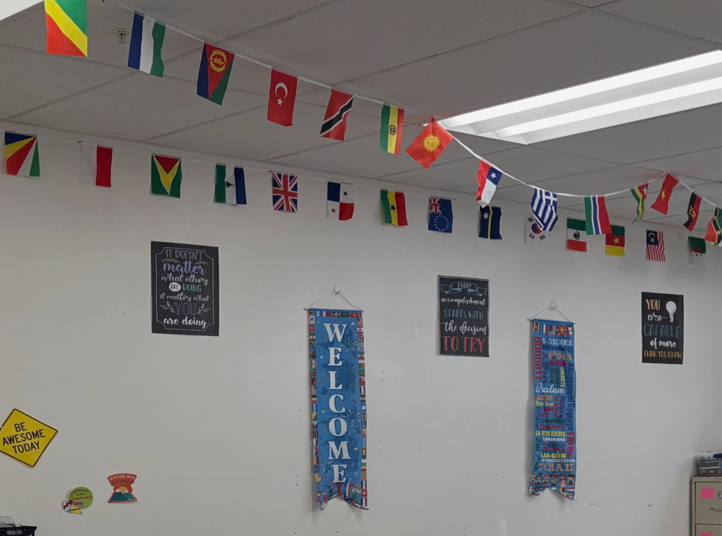
Flags, positive-mindset posters, "welcome" and "thank you" in many languages, even including American Sign Language (ASL) posters, tell students their languages belong in the room. A student might sound out namaste or sayonara on a poster and recognize a word from home.
These routines lower what linguist Stephen Krashen (1982) called the affective filter: the anxiety that can block language learning. Students who feel safe take more risks in speaking and writing.
2. Redefine What it Means to be a “Good Writer”
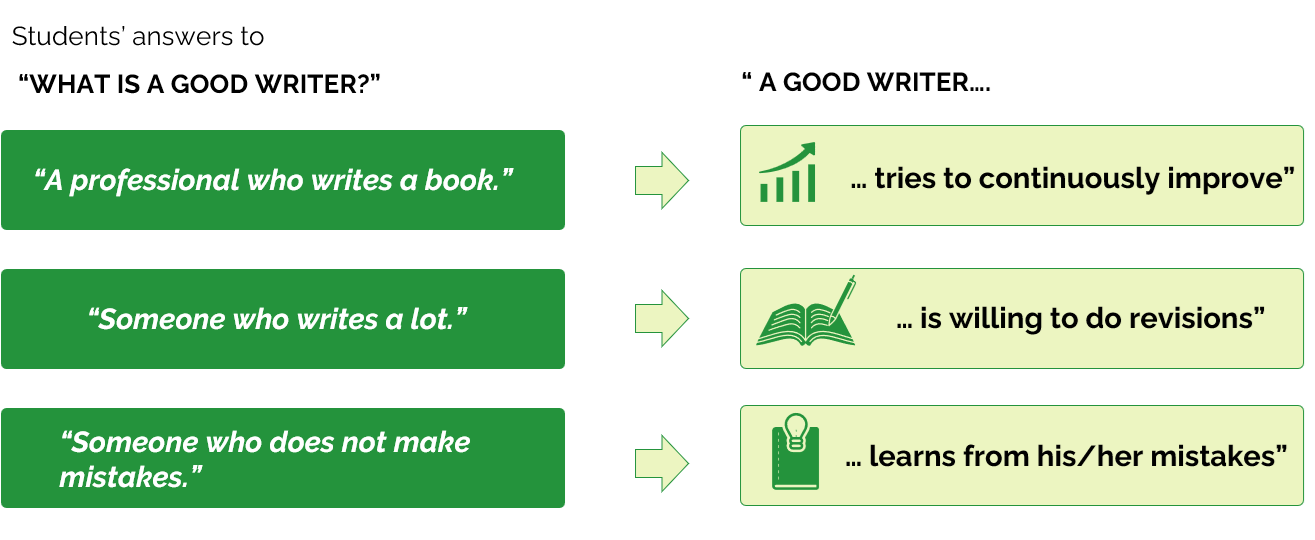
Dr. Peixoto asked her students what makes a good writer, and this exercise explained why many lacked confidence in their writing abilities. They described a good writer as a professional who writes books for a living, someone who writes all the time, and someone who never makes mistakes. With these self-limiting beliefs, students could not see themselves as good writers.
The educator's task is to reframe what it means to be a good writer. Dr. Peixoto explained why anyone can become a good writer if they put in time and effort to improve, revise, and learn.
Feedback sits at the center of this shift in thinking. Dr. Peixoto learned in her training that “feedback is love.” When feedback becomes a normal, positive part of writing practice, students start asking for it.
Research backs this up. In a 2007 review in Review of Educational Research, John Hattie and Helen Timperley found that feedback works best when it shows students what to do next. Praise alone has little effect, so pair it with a clear next step.
3. Adapting Writing Scaffolds by Proficiency Level
As we get into specific writing support, note that scaffolding needs to be adapted to where students are at in their language development journey. Scaffolds should shift as students grow: from building background knowledge, to teaching structure, to refining writing through feedback. Also, appropriate scaffolding is trial and error. When students succeed, remove a support. When they struggle, add it back and teach again.
The table below summarizes the approach for each proficiency level.
| Proficiency level | Instructional focus | Key supports |
| Beginner | Building schema, or background knowledge | Visuals, word banks, cognates, translations, sentence stems and frames, graphic organizers |
| Early intermediate | Teaching the structure of writing | Sentence stems and frames, word banks, graphic organizers, explicit teaching of essay parts |
| Late intermediate and early advanced | Helping students refine writing through feedback | Writing conferences, targeted reteaching, self-check checklists, gradual release of responsibility |
Classroom management tip: Grouping students by proficiency level makes a mixed class manageable.
Writing Strategies for Beginner-Level Multilingual Learners
Beginners need a variety of supports simultaneously, with each built on what they already know. These supports draw on the pre-existing assets, such as the student's home language. These scaffolds should be gradually removed over time.
Model the Graphic Organizer Before Assigning It
Some students have never used a graphic organizer, and others complete one but can't yet move those ideas into an essay. Bridge that gap by showing what the organizer is for, filling it in together, then writing the essay together with the information.
Keep Cognates If Using AI to Modify Texts
When you use an AI tool to simplify a text, prompt it to keep cognates. Lowering a Lexile level often swaps necessity for need, yet a Spanish-speaking newcomer already recognizes necessity from necesidad. Add this line to your prompt: "Keep English-Spanish cognates whenever possible."
In a 2020 study in The Reading Teacher, García, Sacco, and Guerrero-Arias found that bilingual elementary students who received cognate instruction used cognates in their writing, and fourth graders also used them to improve reading comprehension. The same principle of building on the home language applies in grades 6-12.
Build on Students' Schema
Schema is the framework of knowledge and experience that organizes what students already know. During a unit on U.S. holidays, David mentioned that one of his newcomer students connected Halloween to Día de los Muertos. She gathered pictures of the calavera and the ofrenda, or offering, turned them into English words and sentences, and wrote a narrative about her own tradition.
Shared experiences, such as farm life or acts of courage, open the same door. These familiar experiences or beliefs help bridge connections to English. However, remember to check assumptions as you plan. Don't assume that there are always connections. For example, if you describe a beach holiday, recognize that some students have never been to a beach.
Connect Writing to Students' Lives
When assigning writing, invite students to draw on their own experiences. One beginner in Dr. Peixoto's class, Adrian, used the provided sentence stem "According to my life" to write a claim-evidence-reasoning (CER) response about the day his dog barked for help after he fell from a motorcycle at age seven. He closed with a sentence from the provided word bank: "Animals help us in beautiful and difficult times."
Teach Text Structure with Familiar Content
Finally, introduce text structure using a familiar topic, such as making pizza or washing a car. This type of content keeps the exercise low-stress, so students can focus on signal words such as first, next, then, and finally. Rehearsing the steps aloud with a partner adds listening and speaking practice.
Writing Strategies for Early Intermediate English Learners
Early intermediate learners are ready for explicit teaching of writing structure. However, keep scaffolds like sentence stems, frames, and word banks.
Explain Key Words Visually
Academic terms can be confusing, and multiple-meaning words are especially challenging. Using visual cues can help students learn and retain new vocabulary. For example, for many English learners, the word hook suggests only a fishing hook. Use that image: show the hook, then explain the academic use of the word, which means a technique that writers use to draw the reader in.
Give Students a Place to Start
Now, take the word hook, and apply it to writing. Offer four types of hooks (a question, a statement, a fact, or a quote), then provide frames for each part of the essay. Starting is often the hardest part, so narrow the choices and supply the first words.
- Thesis (claim): "Animals help us because..."
- Evidence: "According to..."
- Reasoning: "This is important because..." or "The evidence shows..."
- Conclusion: "In conclusion,..." followed by a suggestion, recommendation, or call to action
With a starting point, students write most sentences independently.
Write Together
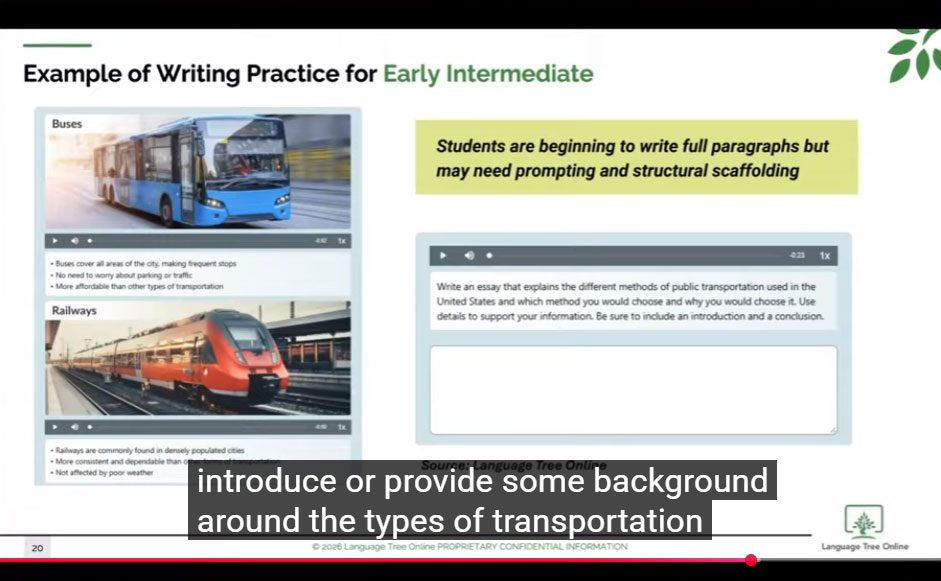
In shared writing, teacher and students compose a text together. For a prompt about transportation, first ask what transportation students knew in the countries where they grew up, then add background on their current city. Unpack the prompt before anyone writes.
Writing Strategies for Late Intermediate and Advanced English Learners
For late-intermediate and early-advanced proficiency writers, feedback takes the lead. The teacher should continue with gradually releasing responsibility.
Hold Short Writing Conferences
A five-minute conference at the teacher's desk can address punctuation, capitalization, or clarity. Reteach shared challenges to the whole class and address individual ones one-on-one.
Teach Sentence Order Across Languages
For example, academic writing in certain languages leans on the passive voice, so English sentences built the same way can sound backward. Help these students re-order sentences, indicate where a reader could pause, and model revisions until students can make them alone.
Lead Comments with Strengths, Then Name the Next Step
Comment directly in students' Google Docs, starting with one to three strengths and then one clear next step. Comments shared in the webinar show the balance: "I love this, and it's true. You are on the right track, keep going," alongside "You forgot your claim here."
A self-check checklist with items such as a hook, a thesis statement, and a claim in each body paragraph lets students judge their own drafts.
Teach Grammar in Context
Grammar taught in isolation rarely sticks. Teach structures such as complex sentences and embedded clauses through familiar topics, since many late intermediate and long-term English learners have never been taught them explicitly. Language takes the driver's seat, and familiar content is the vehicle for practice.
Key Takeaways
The most effective writing strategies for multilingual learners start with a safe space where students feel ready to take risks.
Define a good writer as someone who keeps improving, and make feedback routine.
Match scaffolds to proficiency level: schema for beginners, structure for early intermediate learners, and feedback at higher levels.
Build on students' assets, including cognates, culture, and life experience.
Remove supports gradually, and add them back when students need them.
With a safe space and the right scaffolds, your multilingual learners see that they can express themselves in writing, in any language.
Questions from the webinar (with Answers)
About Language Tree Online
Language Tree Online provides standards-based, multisensory resources specifically designed for middle and high school multilingual learners. The Language Tree Online Performance Indicator gives students realistic practice for the summative ELPAC and ACCESS for ELLs across listening, speaking, reading, and writing, and gives teachers domain-level results that show where to focus instruction before test day. Ready to boost English proficiency AND academic achievement? Learn more about our resources that help you implement these strategies in your classroom.
References
Dove, M. G., Honigsfeld, A., & McDermott Goldman, C. (2025). Nine dimensions of scaffolding for multilingual learners. Corwin. https://www.corwin.com/books/nine-dimensions-287022
García, G. E., Sacco, L. J., & Guerrero-Arias, B. E. (2020). Cognate instruction and bilingual students' improved literacy performance. The Reading Teacher, 73(5), 617–625. https://doi.org/10.1002/trtr.1884
Hattie, J., & Timperley, H. (2007). The power of feedback. Review of Educational Research, 77(1), 81–112. https://doi.org/10.3102/003465430298487
Krashen, S. D. (1982). Principles and practice in second language acquisition. Pergamon.