
The Path to English Learner Reclassification in Grades 6-12
You know the student. She leads her group in discussion, helps a newcomer find the cafeteria, and scored a 4 overall on last spring's summative English language proficiency (ELP) assessment. She is still classified as an English learner, and she wants to know why.
English learner reclassification is the point where a student formally exits English learner status. For students who enter U.S. schools in middle or high school, the window to get there is tight. The path depends on meeting several criteria in the same year, and that alignment rarely happens by chance.
This guide covers what reclassification requires, what the research says about how long it takes, and five practical ways to help your students keep on track for reclassification.

What Does Reclassification Mean for English Learners in Grades 6-12?
Reclassification is the formal decision that a student has met the state's criteria for English proficiency and exits English learner (EL) status. Many states call these students reclassified fluent English proficient (RFEP) or former English learners.
(See the glossary of ELD terms for more definitions, including RFEP and LTEL.)
Each state sets its own path within a federal floor. Under Title III of the Every Student Succeeds Act (ESSA), states must use standardized, statewide exit procedures for English learners. Those procedures must include a proficient score on the annual ELP assessment. Some states, like Georgia and North Carolina, only require a proficient summative score to exit EL services. Other states require additional evidence. California, for example, has four criteria: an Overall Performance Level 4 on the Summative English Language Proficiency Assessments for California (ELPAC), a teacher evaluation, parent opinion and consultation, and a comparison of basic skills performance against English-proficient peers of the same age.
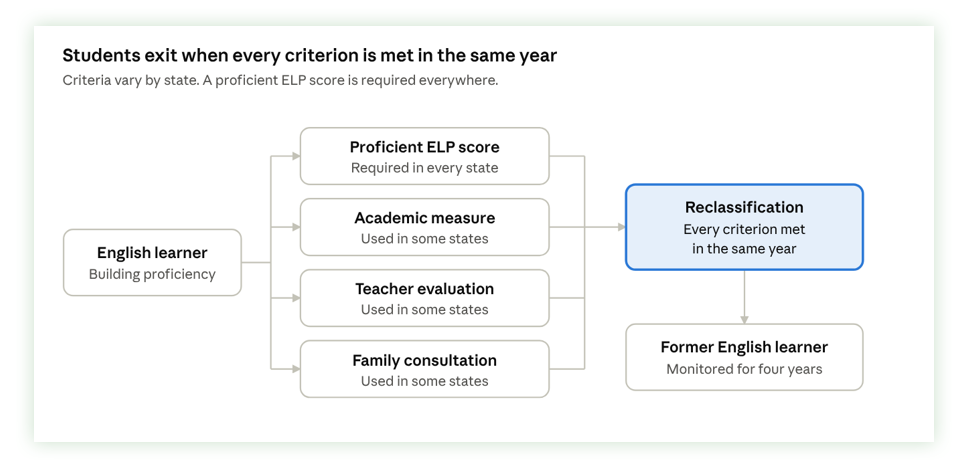
The path to reclassification. Every state requires a proficient ELP score, and some add academic, teacher, and family criteria that students must meet in the same year.
For secondary students, reclassification is more than just a label. It affects schedules, course options, and academic outcomes. Researchers at the National Research and Development Center to Improve Education for Secondary English Learners found that in Oregon, 55 percent of students classified as English learners were enrolled in all four core courses in a given year, compared with 69 percent of former English learners. Reclassification also starts a monitoring period. Districts must report on the academic progress of former English learners for four years after exit.
The bottom line: Timely reclassification is highly important to English learners in the secondary grades.
5 Ways to Support English Learners on the Path to Reclassification
The optimal reclassification plan has these general elements: it starts in the fall, uses data students can understand, and brings every teacher of the student into the plan. The strategies below fit grades 6-12 and work across proficiency levels.
1. Map Your State's Exit Criteria for Each Student
List every criterion your state and district use, the score or evidence each one requires, and where each student stands today. A one-page "reclassification snapshot" per student works well.
For example, a California snapshot would track four rows: the Summative ELPAC Overall Performance Level, the teacher evaluation, the parent consultation, and the local basic skills measure. A student who has met three of the four knows exactly where to focus.
2. Read Domain Scores Alongside the Overall Level
The overall score tells you whether a student met the threshold. The domain scores tell you why. Review reading, writing, listening, and speaking results before you plan instruction.
For example, a student whose overall score sits just below the cut may show strong listening and speaking results and a writing result that pulls the overall score down. That student needs targeted writing support, and a general review of all four domains would spend time where it is not needed.
(Related: The 5 Stages of English Language Proficiency, Explained shows what students can do at each stage.)
3. Build Academic Writing Every Week
Treat academic writing as a year-long routine. Short, frequent practice builds the skill steadily.
Try a weekly claim-evidence-reasoning paragraph tied to current content. Students first rehearse orally with a partner using a frame such as "The text shows ___ because ___." Then they write. Fade the frame as students gain control. Beginning students can work from a fuller frame, while students at higher levels add a counterclaim.
Why it works: Thompson (2017) found that English proficiency develops slowly when it includes text-based literacy. Oral rehearsal before writing also builds listening and speaking practice into every session.
4. Make the Goal Visible to Students
Students who understand the criteria can take ownership of them. Hold a 10-minute conference with each student in the fall and translate the snapshot into student-friendly language.
For example, a student might write: "I have met the speaking and listening targets. This year I will strengthen my writing by adding evidence to every paragraph." Students keep the goal in a notebook and revisit it at each grading period. Naming accomplishments, and showing a concrete path forward, builds the motivation. (Related: Thinking Beyond Test Prep walks through goal-setting conferences step by step.)
5. Coordinate With Content Teachers
Many states and districts include teacher evaluations, grades, or content assessments in their criteria. Those criteria live in content classrooms, so content teachers need the snapshot too.
For example, share each student's snapshot with the English language arts teacher in September and agree on one shared writing target. Both teachers then reinforce the same skill and look for the same evidence.
Why it works: Joshi (2023) found that general education English language arts teacher effectiveness consistently predicted reclassification. Researchers at the National Research and Development Center to Improve Education for Secondary English Learners also found that students taught by content teachers with specialized English learner preparation were more likely to enroll in core courses the following year.
Considerations for Administrators
School and district leaders can shorten the path to reclassification by auditing eligibility, standardizing decisions, and protecting course access.
- Run an eligibility audit when scores arrive. List every student who met the ELP threshold, then check the remaining criteria. Estrada and Wang (2018) found eligible students who were never reclassified, so a yearly audit is a simple safeguard.
- Standardize local criteria and forms. California offers one model: the State Board of Education approved the Observation Protocol for Teachers of English Learners (OPTEL) in 2023 to standardize the teacher evaluation and parent consultation criteria.
- Protect access to core courses. Build schedules so English learners take grade-level content alongside English Language Development (ELD) instruction.
- Use the four-year monitoring period well. Check in on former English learners each grading period during the first year after exit, so any student who needs support gets it early.
Key Takeaways
- English learner reclassification depends on meeting several criteria in the same year, and every state sets its own combination.
- Research shows listening and speaking develop first, while meeting every criterion often takes six or more years.
- Students who enter in middle school have less time, so planning starts in year one.
- Domain scores show where each student's remaining gap sits.
- Weekly academic writing, student goal-setting, and shared targets with content teachers move students forward.
- Yearly eligibility audits help ensure that students who meet every criterion actually exit.
About Language Tree Online
Language Tree Online provides standards-based, multisensory resources specifically designed for middle and high school multilingual learners. The Language Tree Online Performance Indicator gives students realistic practice for the summative ELPAC and ACCESS for ELLs across listening, speaking, reading, and writing, and gives teachers domain-level results that show where to focus instruction so students stay on track for timely reclassification. Ready to boost English proficiency AND academic achievement? Learn more about our resources that help you implement these strategies in your classroom.
References
California Department of Education. (2019). Updated reclassification guidance for 2018–19. https://www.cde.ca.gov/sp/ml/reclassguide1819.asp
Estrada, P., & Wang, H. (2018). Making English learner reclassification to fluent English proficient attainable or elusive: When meeting criteria is and is not enough. American Educational Research Journal, 55(2), 207–242.
Joshi, E. (2023). Unpacking the relationship between classroom teacher characteristics and time to English learner reclassification. American Educational Research Journal. https://doi.org/10.3102/00028312221144755
Regional Educational Laboratory Northeast & Islands. (2016). Patterns of English learner student reclassification in New York City public schools (REL 2017–200). U.S. Department of Education, Institute of Education Sciences. https://ies.ed.gov/ncee/rel/Products/Region/northeast/Publication/3782
Thompson, K. D. (2017). English learners' time to reclassification: An analysis. Educational Policy, 31(3), 330–363.
Umansky, I., & Thompson, K. (2023). Examining policy levers for English learner course access [Research brief]. National Research and Development Center to Improve Education for Secondary English Learners. https://www.elrdcenter.wested.org/_files/ugd/5784a1_cb607bdb7c8443ac80051208df18f509.pdf
Umansky, I., & Thompson, K. (2024). English learners' access to core content [Research brief]. National Research and Development Center to Improve Education for Secondary English Learners. https://elrdcenter.wested.org/_files/ugd/5784a1_c3225833a7134f16ac43dd55a80ad894.pdf